
Key Takeaways
- Marine, bovine, and porcine collagen all deliver the same core amino acids, but they differ in where they come from, how they absorb, and which markets they can reach.
- Tuna collagen is predominantly Type I with smaller peptides, which means faster absorption, a natural fit for beauty and skin health positioning.
- Bovine and porcine collagen are more affordable and widely available, but each carries trade-offs around traceability, disease history, and religious dietary restrictions.
- Marine collagen is the simplest path into halal, kosher, and pescatarian markets without additional certification layers.
- No single collagen source fits every application. The right choice depends on the product, the target consumer, and the markets it needs to reach.

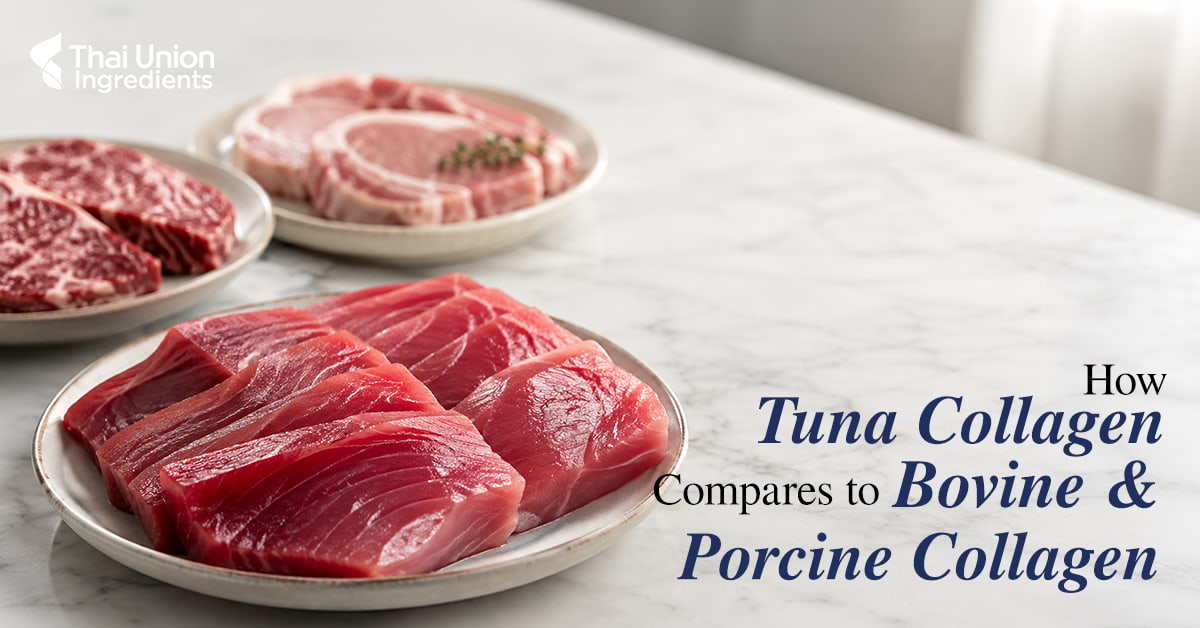
The collagen market has experienced rapid expansion. You’ll see collagen from cows, pigs, and fish next to each other in supplement aisles or on B2B ingredient platforms. Their promise is identical: to provide the amino acids essential for skin, bone, joint, and connective tissue health. However, the origin of each ingredient reveals a distinct narrative. This narrative significantly influences its performance and target market for formulators.
Therefore, when evaluating tuna collagen vs bovine collagen or porcine collagen, the answer is not about which source is universally superior. It is about which one aligns with the product's performance targets, the intended consumer, and the markets it needs to reach.
Three Sources, Same Protein, Different Stories
Collagen is the same at the molecular level. All protein, regardless of its source (cow, pig, or tuna), is composed of the same amino acids: glycine, proline, and hydroxyproline. The body utilizes these as foundational elements for preserving skin suppleness, ensuring joint mobility, and facilitating tissue regeneration.
Research indicates that the body experiences advantages in various aspects
- Bovine collagen comes from cows, specifically the hides and connective tissue. It is rich in both Type I and Type III, giving it a broad structural profile that covers skin, bone, and gut applications.
- Porcine collagen comes from pigs, primarily the skin and connective tissue. It is structurally the closest to human collagen, which is why it has a long history in biomedical and cosmetic use.
- Tuna collagen comes from tuna skin, typically a by-product of seafood processing. It is predominantly Type I, the most abundant collagen type in human skin, making it a natural match for beauty and skin health formulations.
Same protein family, different profiles. That is where the sourcing story starts to matter.
Where Each Source Comes From and Why It Matters
Bovine and porcine collagen are by-products of the livestock industry. Supply is large and costs are low, which is why they have dominated the market for decades. But that supply chain carries its own baggage. Bovine collagen has a historical association with transmissible diseases like BSE, which has led some markets to tighten import and testing requirements. Porcine collagen faces fewer disease concerns, but its origin from pigs makes it a non-starter in certain regions and for certain consumer groups.
Tuna collagen proceeds in a different direction altogether. It is derived from the skin of wild-caught Yellowfin tuna, which is a co-product of commercial seafood production. Traceability from a vertically integrated producer covers the entire journey, from the vessel and catch area to the final powder. Brands focused on transparency and responsible sourcing increasingly expect that level of documentation.
How Absorption and Peptide Size Compare
Once collagen is hydrolyzed into peptides, it needs to pass through the intestinal wall to reach the tissues where it is used. This is where peptide size makes a real difference.
Marine collagen peptides are generally smaller in molecular weight than bovine or porcine peptides. Tuna collagen produced through enzymatic hydrolysis can reach molecular weights below 2,000 Daltons, which allows for faster and more complete absorption. This is often described as higher bioavailability, and it is one of the main reasons marine collagen has gained traction in the beauty-from-within segment.
However, collagen from cows and pigs is still well-absorbed when it’s hydrolyzed. Land-based sources are not ineffective. However, marine sources provide a distinct advantage in absorption speed, which is crucial for products where customers anticipate noticeable outcomes.
Who Can Actually Use It
This doesn’t prevent using bovine or porcine collagen for all applications. However, the selection of the source directly influences the extent of commercial door access.
- Religious and dietary fit: Porcine collagen is not permitted in halal or kosher markets. Bovine collagen requires halal-certified slaughter to qualify, adding a certification layer. Marine collagen from fish is naturally considered halal and generally accepted as kosher, which opens the product to a much wider global consumer base without extra steps.
- Sustainability messaging: Collagen derived from seafood processing by-products fits into circular economy and waste reduction narratives. For brands targeting environmentally conscious consumers, marine sourcing is an easier story to tell.
- Clean label positioning: A single-source, minimally processed marine ingredient supports the kind of clean label claims that wellness-focused buyers are looking for on shelf.
None of this rules out bovine or porcine collagen for every use case. But it does mean that the sourcing choice directly affects how wide the commercial door opens.

Matching the Source to the Product
In any comparison of marine collagen ingredients, the most useful lens is application fit. Here is how the three sources typically line up:
- Skin, beauty, and nutricosmetics: Tuna collagen's Type I dominance and smaller peptides make it a strong match for products positioned around skin hydration, elasticity, and anti-aging. Clinical results show +68% hydration, +26% skin density, +16% skin elasticity, and 10% reduced water loss.
- Joint and bone health: Bovine collagen's Type I and III profile suits musculoskeletal applications well. Tuna collagen offers a Type I alternative where bovine is not viable, with in vitro cell studies on tuna collagen peptides indicating around a 70% increase in calcium deposition in bone-forming cells, supporting bone formation.
- Hair health: Tuna collagen peptides support hair wellness through follicle-related pathways. In hair follicle cell assays, they reduce the activity of 5-alpha reductase by approximately 20%, an enzyme linked to hair thinning. Lowering its activity supports stronger follicles and reduced hair loss, making tuna collagen well-suited to hair wellness nutricosmetics.
- Wound support: Skin recovery is another emerging application. In fibroblast assays, tuna collagen peptides improve wound closure by around 20% at 16 hours and reach full closure roughly 3 hours ahead of the control, pointing to relevance for skin repair formulations.
- Cost-sensitive or high-volume products: Porcine collagen remains the most affordable option where religious or dietary restrictions are not a factor.
- Halal, kosher, and export-ready formulations: Marine collagen is the most straightforward path to multi-market compliance.
The decision is rarely about which collagen source is the best in absolute terms. It is about which one is the best fit for the specific product, consumer, and market in front of you.
Finding the Right Collagen Source for Your Next Product
When weighing tuna collagen vs bovine collagen and porcine collagen, the differences in sourcing, absorption, market access, and sustainability are real. But they do not point to a universal winner. The choice of sourcing should correspond with the product’s objectives, its intended audience, and the regulations it must adhere to. Tuna collagen is a great choice for formulations requiring Type I dominance, high bioavailability, and halal/kosher compatibility.
Thai Union Ingredients produces ThalaCol™, a hydrolyzed tuna collagen peptide powder derived from wild-caught Yellowfin tuna skin with end-to-end traceability. Processed using German-engineered hydrolysis technology, it delivers Type I peptides that support skin, bone, and hair health. Contact their team for pricing, COAs, or technical support to move your next formulation forward.
References:
1. Suitability of Marine and Porcine Derived Collagen Type I Hydrogels for Bioprinting and Tissue Engineering Scaffolds. Retrieved 7 July, 2026 from https://www.ncbi.nlm.nih.gov/pmc/articles/PMC9227984/
2. Learn the Benefits of Sourcing Marine Halal Collagen. Retrieved 7 July, 2026 from https://www.thalaingredients.com/learn-the-benefits-of-sourcing-marine-halal-collagen/
3. Clinical Study: ThalaCol™ Tuna Collagen Peptide. Retrieved 7 July, 2026 from https://www.thalaingredients.com/tuna-collagen-peptide-clinical-trial/
4. What Is Collagen, and What Does It Do? Retrieved 7 July, 2026 from https://www.thalaingredients.com/what-is-collagen/
5. Foods With Collagen to Add to Your Diet. Retrieved 7 July, 2026 from https://www.thalaingredients.com/collagen-food-sources/
Frequently Asked Questions About Tuna Collagen, Bovine and Porcine Collagen
Q: What are the main differences when comparing tuna collagen vs bovine collagen?
A: Both share the same core amino acids, but tuna collagen is predominantly Type I with smaller peptides that absorb faster. Bovine collagen contains both Type I and Type III and has a longer track record in joint and musculoskeletal products. Tuna collagen also fits halal and kosher markets without requiring additional slaughter certification.
Q: How does tuna collagen vs porcine collagen compare for supplement formulations?
A: Porcine collagen is structurally the closest to human collagen and is typically the most affordable option. However, it is not permitted in halal or kosher markets, which limits its reach. Tuna collagen offers broader market access and a bioavailability advantage due to its smaller peptide size.
Q: Is tuna collagen suitable for halal and kosher products?
A: Yes. Fish collagen is naturally considered halal and generally accepted as kosher, making it the simplest collagen source for products entering these markets. ThalaCol™ from Thai Union Ingredients carries both halal and kosher certifications.
Q: Which collagen source works best for skin health formulations?
A: Tuna collagen is a strong fit for skin health products because it is predominantly Type I, the most abundant collagen type in human skin. Its smaller peptide size also supports higher bioavailability, making it well suited for nutricosmetic and beauty-from-within applications.