
Key Takeaways
- End-to-end means one owner: An integrated marine ingredient supply chain places catch, processing, refining, and finished-ingredient production under a single accountable operator.
- Fragmentation is the real risk: Long, multi-party sourcing routes are where quality variation, traceability gaps, and mislabeling tend to creep in.
- Control compounds into quality: A vertically integrated ingredient supplier can hold specifications steady from raw material to final batch.
- Traceability becomes provable: Traceable marine ingredients let brands document origin from the fishing zone to the certificate of analysis.
- Sustainability is a sourcing lever: Whole-fish utilization and responsible sourcing turn supply chain control into a measurable environmental advantage.
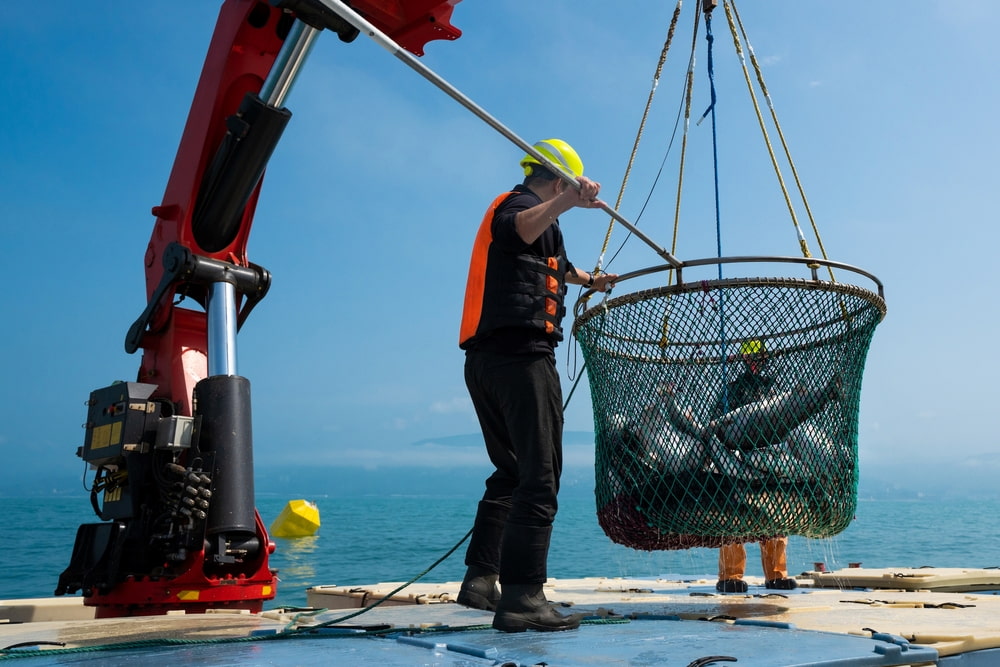
Quality marine ingredients don’t begin in the laboratory but they start at sea. Every step between the fishing vessel and the finished product impacts what ultimately reaches a formulator’s hands. That’s why a growing number of nutraceutical and food brands partner with a single marine ingredients provider who can manage the entire journey, from catch to certificate of analysis.
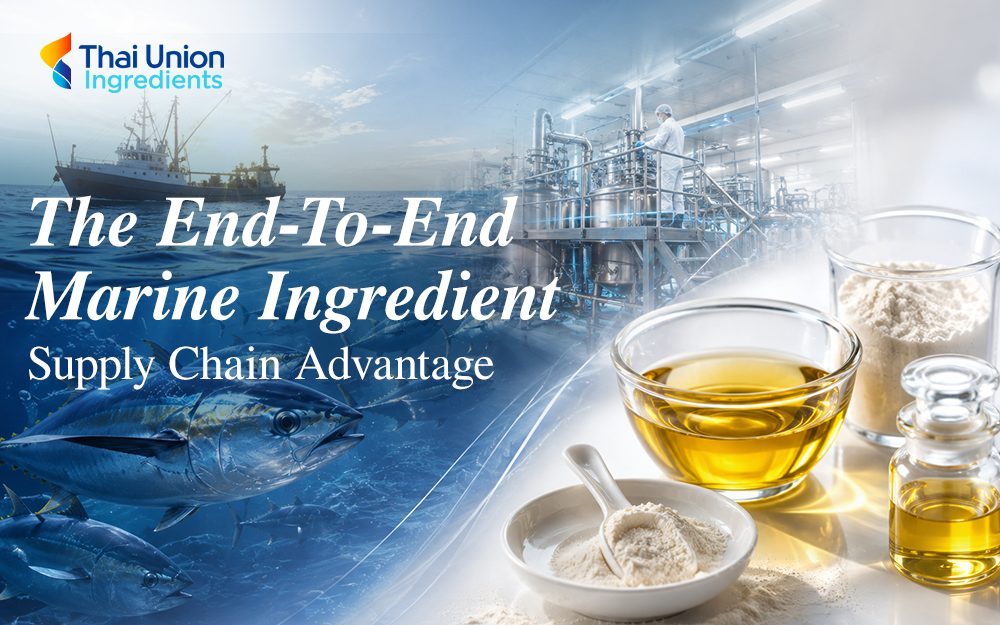
Thai Union Ingredients is set up around that idea. As the B2B ingredient arm of Thai Union Group, one of the world's largest seafood companies, it operates an end-to-end marine ingredient supply chain, with tuna and other co-products moving from the group's own seafood operations into ingredient production and traceable documentation carried at each step.
What An End-To-End Marine Supply Chain Means

An end-to-end, or vertically integrated, marine ingredient supply chain brings catch, primary processing, extraction, refining, testing, and finished-ingredient production together under one operator. At Thai Union Ingredients, that means raw material stays within a single system of standards as it moves from Thai Union Group's fishing operations through to a finished collagen peptide, oil, or calcium ingredient. For buyers of marine ingredients, this structure makes it easier to see an ingredient's full journey and to verify origin with documentation rather than assumption.
The Hidden Cost Of Fragmented Sourcing
Marine raw materials often travel through long global supply chains before they become an ingredient. For instance, more than 90 percent of the seafood consumed in the United States is imported, and illegal, unreported, and unregulated fishing is estimated to account for 13 to 31 percent of the global catch. Fewer transfers along the way generally mean fewer opportunities for information to be lost. At Thai Union Ingredients, the fish entering the ingredient lines come from within Thai Union Group's own network, which keeps that journey short and documented from the outset.
How Vertical Integration Changes The Math
Vertical integration brings a number of moving pieces under one roof, from the choice of vessels and species that feed the line to the pace at which raw material moves into processing and the specifications that guide each stage. When a vertically integrated ingredient supplier sets those parameters, freshness tends to hold up better and specifications stay more consistent across batches.
There is a second benefit that is easy to miss. Thai Union Ingredients draws on fish heads, frames, skins, and trimmings from Thai Union Group's own primary processing to produce calcium, collagen, and oil, so those co-products come from a known source within the same system.
Consistency You Can Build A Formula On
Consistency is where supply chain control shows up on the certificate of analysis. Marine ingredient quality depends on variables set long before packing: the species, the freshness of the raw material, the extraction parameters, and the testing regime. When those variables sit with one operator, batch-to-batch variation tends to narrow.
That reliability is what product teams weigh when working out how to choose a marine collagen peptide manufacturer for nutraceutical products. Molecular weight, dissolution, taste, and purity all trace back to process control. Because Thai Union Ingredients owns both its tuna raw material and the hydrolysis process behind its ThalaCol™ tuna collagen peptides, those attributes are managed within a single system from raw material to finished batch.
Traceability From Catch To Certificate
Traceability means being able to follow an ingredient backward, from the certificate of analysis to the fishing zone it came from. Good systems record the catch area, vessel, date, species, and gear used, then carry that data forward through each processing step. Traceable marine ingredients also support compliance with regulations such as the EU IUU Regulation and the US Seafood Import Monitoring Program, which now require documented origin for many products.
Because Thai Union Ingredients' raw material moves through Thai Union Group's own vessels and processing sites, that documentation follows the ingredient through the chain, giving brands something concrete to share with customers, auditors, and regulators.
Supply Security In A Volatile Ocean
The ocean doesn't run on a factory timetable. Seasonality, weather, stock health, and regulatory changes all influence availability, and brands feel that upstream variability in their own planning cycles.
Operating its own primary processing and holding finished-ingredient inventory gives Thai Union Ingredients room to plan capacity around forecasted demand, which helps reformulations and product launches stay on track when the marine ingredients behind them arrive on schedule and on specification, quarter after quarter.
Sustainability As A Sourcing Decision
Sustainability and supply chain control are more closely linked than they first appear. Whole-fish utilization, which puts co-products that would otherwise be waste to use, draws more nutrition from every fish landed and eases the pressure to catch more. This approach works well when one operator runs both primary processing and ingredient production, and it is how Thai Union Ingredients operates today.
The same visibility supports responsible sourcing, and Thai Union Ingredients' credentials speak to that across four areas. On sustainability, the company holds MSC, Friend of the Sea, ASC, MarinTrust, and Dolphin Safe certifications. Food safety is covered by HACCP, GHP, GMP, and FSSC 22000. Ethical trade is verified through Sedex membership, and religious compliance through Halal and Kosher certifications. Together, these give brands documented evidence to stand behind their sourcing choices.
Why Partner With Thai Union Ingredients
Thai Union Ingredients puts this model into practice. Few companies have the scale to maintain complete visibility across the marine ingredient value chain. Thai Union Ingredients is one of them. As the B2B marine ingredient arm of Thai Union Group, one of the world's largest seafood producers, it runs a vertically integrated supply chain that delivers total traceability from catch to finished ingredient. The company builds its portfolio on the principle of using every part of the fish, converting raw material from its own operations into functional ingredients rather than sourcing co-products from unverified suppliers. That portfolio spans UniQ®OMEGA tuna and cod liver oils, ThalaCol™ tuna collagen peptides, AzureCol™ tilapia collagen peptides, and UniQ®BONE tuna calcium, serving the supplement, food and beverage, nutricosmetic, and pet nutrition sectors. Each line is backed by the same traceable, sustainable sourcing and the strict global safety standards the company holds itself to.
For a brand, the appeal of a vertically integrated ingredient supplier like this is straightforward: fewer intermediaries, provable origin, and consistent marine ingredient quality from a single accountable partner.
As oceans face more pressure and buyers ask harder questions, the distance between a brand and the water its ingredients come from is becoming a competitive factor in its own right. Working with a single, transparent marine ingredients provider like Thai Union Ingredients closes that distance. The Thai Union Ingredients team can guide you on sourcing, specifications, and samples to understand how an end-to-end approach suits your upcoming formulation.
References:
1. Tackling Challenges of Global Seafood Traceability Programs (NOAA Fisheries). Retrieved July 6, 2026, from:
https://www.fisheries.noaa.gov/feature-story/tackling-challenges-global-seafood-traceability-programs
2. Evolution of Traceability and Catch Documentation in the FAO (Global Dialogue on Seafood Traceability). Retrieved July 6, 2026, from:
https://thegdst.org/evolution-of-traceability-fao/
3. 5 Challenges to Seafood Traceability (Greenpeace). Retrieved July 6, 2026, from:
https://www.greenpeace.org/usa/5-challenges-to-seafood-traceability/
4. US Consumer Preferences for Seafood Traceability (MIT Center for Transportation and Logistics). Retrieved July 6, 2026, from:
https://ctl.mit.edu/pub/thesis/us-consumer-preferences-seafood-traceability
Frequently Asked Questions About Marine Sourcing
Q: What is an end-to-end marine ingredient supply chain?
A: It is a model in which one company controls every stage of production, from catch through processing, refining, and finished-ingredient manufacturing. A vertically integrated marine ingredient supply chain keeps the raw material inside a single system with one set of standards, which makes origin and quality far easier to verify than in a multi-party trading model.
Q: How to choose a marine collagen peptide manufacturer for nutraceutical products?
A: When deciding how to choose a marine collagen peptide manufacturer for nutraceutical products, look at process control first. Molecular weight, solubility, taste, purity, and batch consistency all depend on who owns the raw material and the hydrolysis. A manufacturer with a traceable, vertically integrated chain can hold those attributes steady, which is harder for a trader sourcing collagen from rotating suppliers.
Q: Why do traceable marine ingredients matter for brands?
A: Traceable marine ingredients let a brand document where a product came from, from the fishing zone to the certificate of analysis. That supports compliance with rules like the EU IUU Regulation and the US Seafood Import Monitoring Program, and it turns sustainability and purity claims into facts the brand can prove rather than assert.
Q: How does vertical integration improve marine ingredient quality?
A: A vertically integrated ingredient supplier sets the specification at every stage, so freshness, grade, and testing stay consistent from catch to finished batch. That control is the main reason marine ingredient quality is more reliable from an integrated operator than from a fragmented chain of independent handlers.